
The Hidden Cost of Launching Cold on GivingTuesday

GivingTuesday has gotten huge. In 2025, an estimated 38.1 million people in the U.S. took part, giving a combined $4 billion, and that number keeps climbing year over year. With numbers like this, it's tempting to treat the day itself as the whole strategy: build one great email, hit send on December 1, and watch the donations roll in.
Here's the thing though. If you wait until the last week of November to say anything to your audience, your message is landing in one of the most crowded inboxes of the year, right alongside everyone else's. A single great appeal, launched cold, usually just becomes background noise.
So let's talk about what actually works instead, and why October (right now!) is a genuinely good time to be thinking about this.
What launching cold actually costs you
A last-minute appeal isn't really a strategy so much as a hope. And when it falls short, it's easy to blame "donor fatigue", but that's often not quite the right diagnosis. What's really happening is closer to relevance fatigue: people aren't tired of giving, they're tired of being hit with generic, interchangeable asks all at once, with nothing to distinguish one from another.
There's a related problem with relying on a single channel. One big email blast on December 1 can easily get buried under everyone else's big email blast on the same day. Organizations that consistently hit their GivingTuesday goals tend to build several touchpoints across email, social, and other digital channels well before the day itself, so their name is already familiar by the time the ask arrives.
And even when the message does land, there's a second, quieter place things fall apart: the moment someone actually tries to give. If a donor clicks your link on their phone and the checkout process takes more than a minute or two, a lot of them will simply give up partway through. Winning someone's attention and then losing them at the donation form is one of the more avoidable ways to lose a gift. It's also one of the easiest things to test for ahead of time, which is exactly why it's worth doing now rather than finding out on the day.
But don't start too early, either
All of this might make it tempting to start promoting GivingTuesday in August. We'd gently push back on that. Part of what makes the day work is its sense of occasion, a little bit of scarcity, a little bit of "this is happening now". Pushing hard months in advance tends to wear that down before it's even arrived.
There's a practical cost too. Communicating heavily, months ahead of time, tends to drive up unsubscribe rates right before your busiest and most important sending window of the year, your end-of-year ask in December. That's not a trade worth making.
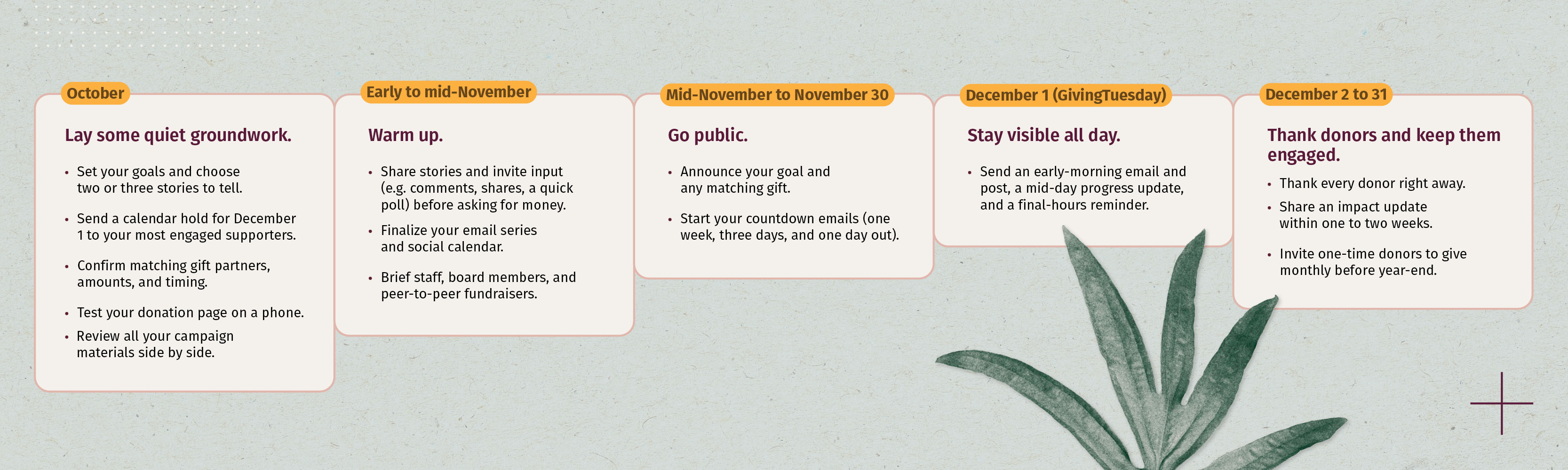
So if you haven't started yet, take a breath: you haven't missed anything. October sits in a genuinely good spot, a window for behind-the-scenes groundwork, while saving the bigger public push for mid-November, when people are actually primed to pay attention.
What that October groundwork buys you
Quietly starting your preparation now doesn't just avoid the pitfalls above. It sets a few things in motion that are hard to build later.
It warms things up before you ask for anything. October gives you room to engage your supporters by asking for their attention, their input, a share, a comment, before you ask for their money. That's a much softer entry point, and it tends to make the eventual ask feel like a continuation of a conversation rather than a cold open.
It's a good moment to reach younger supporters. GivingTuesday is genuinely effective at bringing in younger donors; a commonly cited figure puts participation at 82% among 18 to 34 year-olds who are already aware of the day. Engaging that group early, before the noise of late November, helps build a relationship that outlasts the day itself.
It gives your leadership time to line up matching gifts. Corporate matches take coordination, and that coordination is much easier to do calmly in October than in a scramble in late November.
It's also the right time to make sure everything looks and sounds like you. This is the part that often gets missed in a fundraising-focused checklist, but it matters just as much as the strategy behind it. By the time your campaign goes live, your email, social posts, donation page, and any print or signage should all feel like they came from the same place (the same colours, the same tone, and the same core message). And you should say it consistently, rather than reinventing it for each channel. A donor shouldn't have to work to recognize you as they move from one touchpoint to the next. October is a good time to actually check this, not assume it.
A few things worth doing this month
None of this needs to be complicated. A few concrete places to start:
- Send supporters a “save the date” now. A simple calendar invite, sent to your most engaged supporters, means your campaign is already sitting on their phone weeks before December 1, rather than competing for attention that morning.
- Test your mobile checkout today. Walk through your own donation flow on a phone, right now, and time it. If it takes more than a minute or two, that's worth fixing well before traffic picks up.
- Take a look at your materials as a set, not one at a time. Pull up your email draft, your social graphics, and your donation page side by side. Do they look like they belong together, or does each one feel like it was made by a different team?
- Make sure your matching gift conversations are already underway. If a corporate partner is involved, now's the time to confirm the details, not the week of.
None of these take a huge amount of time on their own. What they do require is starting now, rather than waiting and hoping it all comes together.
Get the full plan: Beacon's GivingTuesday Preparedness Checklist
Those four steps are a good start, but they're only part of the picture. A GivingTuesday campaign has a lot of moving parts: goals, donor segments, an email series, social posts, a donation page, the day itself, and the follow-up that turns first-time donors into regular ones. When everyone on your team is already busy, it's easy for one of those pieces to slip.
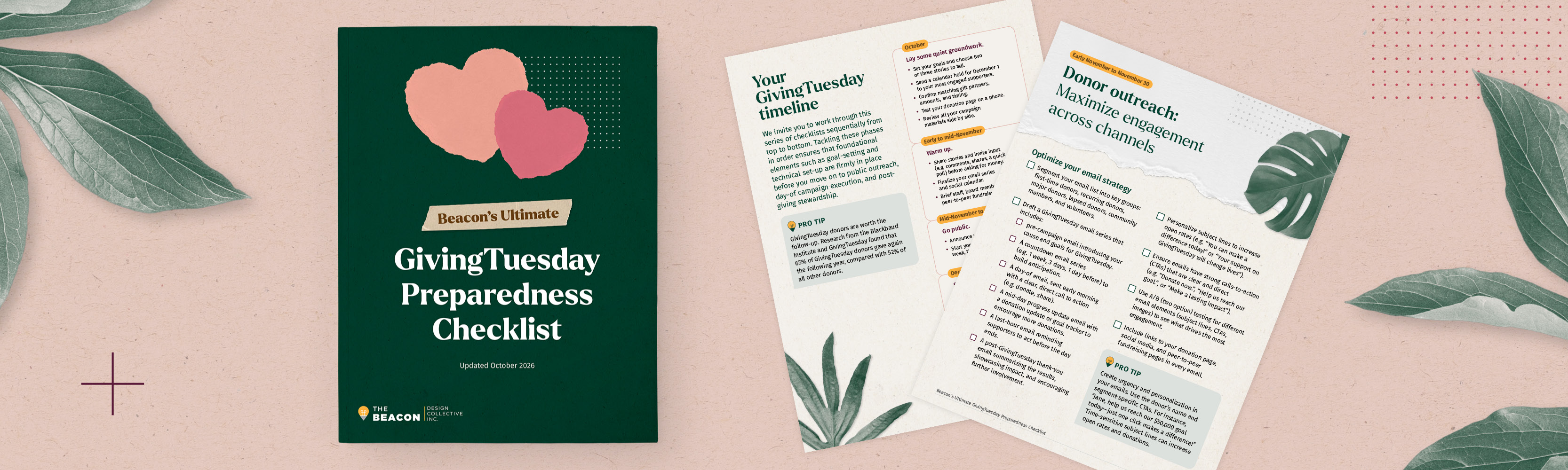
That's why we've refreshed Beacon's Ultimate GivingTuesday Preparedness Checklist. It's free, and it's built for the stage you're in right now. Inside, you'll find:
- A timeline from October to the end of December, so you know what to do now and what can wait until November
- Step-by-step checklists for each stage of your campaign, from planning and donor outreach to your donation page, the day itself, follow-up, and measuring results
- A brand consistency check to make sure your emails, posts, and donation page look and sound like they belong together
- An accessibility check, so everyone in your community can read, watch, and give
- Pro tips and sample wording you can adapt, from email subject lines to day-of progress updates
The checklist works whether this is your first GivingTuesday or your tenth. If you're new, it gives you a clear order of operations. If you've done this before, it's a quick way to catch gaps before they cost you a gift.
One simple way to use it: share it with your team, go through it together in a single meeting, and give each section an owner. By the end of the hour, everyone knows what they're responsible for between now and December 1.

One last thing
GivingTuesday doesn't have to rely on luck. A little quiet work in October goes a long way on December 1.
Most teams have at least one GivingTuesday task they wish they'd started earlier, so, what's yours? Send us a message or email us. We'd love to hear how you're getting ready.